
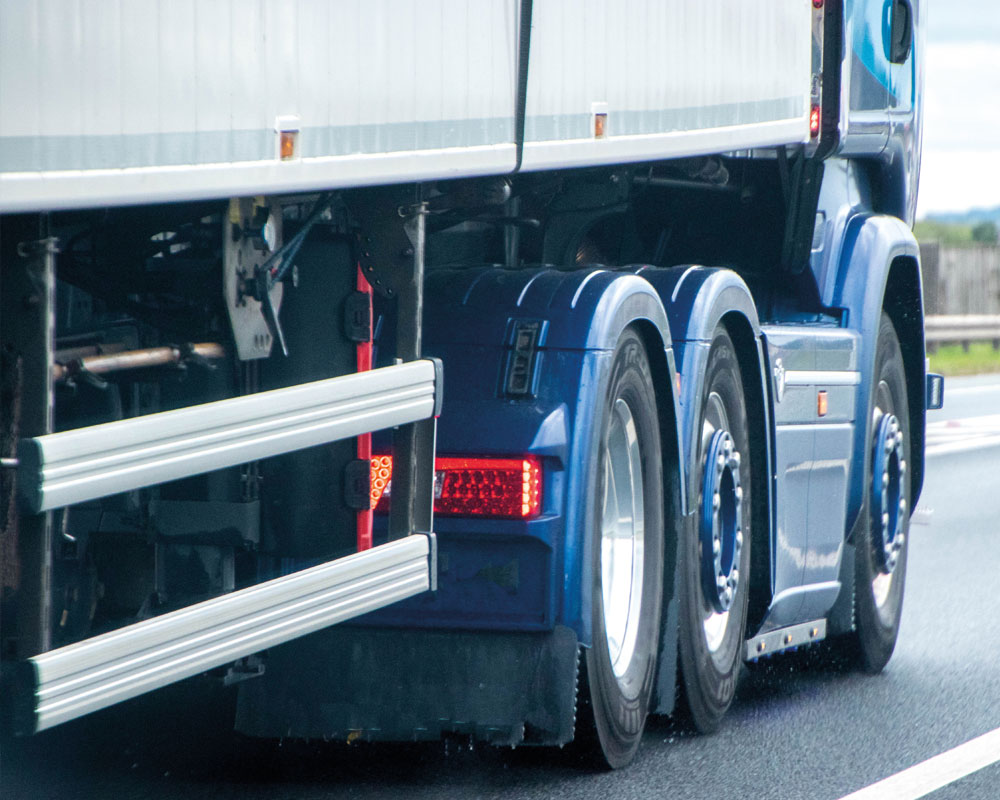

On 20th July 2021 the Government issued an open letter to the UK Logistics Sector, announcing its various plans to increase the number of lorry driving tests over the next few months and ongoingly.
The shortage of HGV drivers has been known about for several years - we published an article on it in 2016 with advice from our HR Consultant, Kevin McIvor, (click here to view) as to what haulage firms could do to recruit and retain staff, but it seems that the pandemic restrictions and possibly Britain's exit from the EU have both exasperated the situation and brought it (finally?) front and square in the Government's line of sight.
The Road Haulage Association is on record as stating there is a shortage of about 60,000 drivers with, they estimate, around 30,000 HGV driving tests lost in 2020 due to the Covid-19 pandemic restrictions. This has obviously had an immediate deleterious affect on the industry and its ability to maintain deliveries across the country. But as well as a bottle neck being inserted in the supply of new drivers, the number of people leaving the industry at the other end seems to have increased. The average age of a truck driver is 55 years old, and many drivers opted for early retirement in 2020 due to the pandemic, or chose to pursue alternative careers outside of trucking due to Covid-19 health concerns. A double whammy for the sector.
Increase in Number of Test Available:
The government's solutions for assisting the sector to address these issues involve the immediate increasing of HGV driver testing. The Driver and Vehicle Standards Agency (DVSA) is allocating additional staff to the testing roles so that they can increase the throughput of successful tests from 1,150 per week pre Covid-19 to 1,500 per week currently. The plan is to sustain this increase and move it to 2,000 successful passes a week. This is being achieved by asking testing staff to work overtime and also diverting staff from other duties, such as considering changes relating to requirements for newer car licence holders to take extra tests to drive car/van and trailer combinations. The thinking on that being that removing this additional test requirement will allow more capacity within the system for Heavy Goods Vehicle testing.
A consulation is to take place on the possible delegation of the off-road manoeuvres part of the HGV test, which would help increase overall testing capacity, as well as looking at issuing provisional licence entitlements to drive articulated lorries at the same time as issuing provisional licence entitlements to drive rigid lorries - thereby allowing candidates to move directly to taking articulated lorry tests without having to have passed a rigid lorry practical test. The open letter states that these changes to the regulatory regime will be reviewed over the next few months with a view to implementing them as early as possible this year.
Cost of Entry to Sector to be Addressed:
The cost of training to be an HGV driver is also being looked at, with apprenticeships being introduced or revised for the industry. For example the Large Goods Vehicle Driver apprenticeship standard (which will be available from 2nd August 2021) will be supported by an increased funding band of £7,000.00.
But perhaps the most radical change that is proposed is the announced relaxation to drivers' hours rules to address "the current urgent situation". This, the government states will provide haulage operators with "increased flexibility to manage deliveries and alleviate some of the pressures being experienced". The relaxation which was announced on 7th July 2021 states:
The retained EU drivers' hours rules can be temporarily relaxed as follows;
The replacement of either:
- the permitted increase to the daily driving limit from 9 hours to 10 hours with one of 11 hours (allowed up to twice in one week)
OR
- the requirement to take a regular weekly rest period of 45 hours in a two week period with an alternative pattern of weekly rest periods as specified below, and an increase to the fortnightly driving limit from 90 hours to 99 hours. This enables two consecutive reduced weekly rest periods to be taken.
The alternative pattern of weekly rest periods for drivers using the relaxation related to weekly rest periods is as follows:
- the regular weekly rest period in a two week period can be replaced by two reduced weekly rest periods of at least 24 hours.
- following this, two regular weekly rest periods must be taken. However, any reduction in weekly rest shall be compensated for in the normal way by an equivalent period of rest taken before the end of the third week following the week in question.
- in addition, any rest taken as compensation for a reduced weekly rest period shall be attached to a regular weekly rest period of at least 45 hours (which can be split over two regular weekly rest periods).
This relaxation must not be used in combination with existing rules for international driving, which allow for two consecutive reduced weekly rest breaks in certain circumstances.
It is not recommended this relaxation be used for drivers engaged partly in international journeys.
The temporary relaxation applies from 12:01 on 12th July 2021 and runs until 11:59 on 8th August 2021. In order to take advantage of the situation Operators must notify the Department for Transport (DfT) that they are doing so. Failure to comply with the requirement to notify the DfT would be an "indication to enforcement authorities that the relaxation had been used inappropriately and a follow up investigation may occur". More information can be found by clicking here.
The open letter (click here to read in full) discusses the possibility of extending this temporary relaxation and even making it permanent. Shortly, the Government will launch a targeted "Call for Evidence" to consider if longer relaxations would be appropriate. The industry would be wise to ensure that they take advantage of this consultation when it arrives.
One thing is certain - it is a very fluid time for haulage businesses at the moment, which may or may not lead to issues with your regulatory compliance. If you are in doubt as to what your drivers or employees should be doing then call 01279 818280 or click here to send an email. Our team is here to help.
More News and Insight
DVLA Confirms New Rules for Professional Drivers Living with Diabetes
From Friday 7th November 2025 the rules were changed to allow diabetic drivers of PSV’s and HGV’s to monitor their glucose levels using Continuous Glucose Monitoring Systems….
Carrying Your Own: Horses to Widgets? Do you Need an O Licence?
The DVSA recently released a press release about the rules for transporting horses in horse boxes and trailers following an update on the guidance about using a tachograph in the vehicle being used to transport the animals…
The Senior Traffic Commissioner’s Statutory Guidance
The value of The Statutory Guidance Documents and the importance to operators, nominated transport managers and other professionals involved in the operation and driving of large commercial vehicles cannot be overstated…
Walkaround Checks – Where Road Safety Starts
Every day, often before the sun is above the horizon, hundreds of thousands of commercial vehicles are started up by their drivers and then they head out on to the UK’s road network to transport goods or passengers from one point to another, often with demanding time constraints thrown into the mix…
Traffic Commissioner’s Annual Report 2024/25: “Don’t Look Back in Anger”
Time has flown by and once again we find that the schools are back after the long summer break and the Office of the Traffic Commissioner has issued its annual report to the Secretary of State, providing a review of the year…
An Apple a Day to Keep the DVLA Away – A review of the DVLA’s Rules on Health Checks for Professional Drivers
There has been some discussion in the industry trade press recently that has highlighted proposed changes to how the disease of diabetes is monitored in professional drivers by the DVLA. One article in RouteOne Magazine stated that…
Light Goods – Heavyweight Industry: The DVSA’s New LGV Strategy
While relatively small in overall physical size light goods vehicles (LGVs) are now a large part of the UK road transport industry. There are currently estimated to be over 5.1 million light goods vehicles on UK roads today…
Employment Law Update – A tale like Scylla & Charybdis
Operators currently face their own real time nightmare in the form of a modern day version of the Greek mythological tale of Scylla and Charybdis (where sailors faced a narrow strait through which they had to pass which had a monster on one side and a whirlpool on the other!)…
Labour Government – Employment Rights Bill – What Will It Mean for Transport Businesses?
In October 2024 the Deputy Prime Minister, Angela Rayner set out her intention to reform the employment rights held by employees in the UK. In a press release issued at the time she is quoted a saying…
Revisiting the DVSA’s Guide to Maintaining Roadworthiness
In April 2025 the Driver & Vehicle Standards Agency (DVSA) issued the latest edition of its Guide to Maintaining Roadworthiness.
The Wheels on the Bus go Round & Round….but how do they Stop?
At the tail end of 2024 a Public Inquiry was held in front of Traffic Commissioner Kevin Rooney where the subject of brake maintenance practices was called into question…
Maintenance Provision Rating Scheme for Commercial Vehicle Workshops is Launched
One of the key tenants of running a commercial vehicle operation, whether ‘HGV’ or ‘PSV’ is that the maintenance of the vehicles is paramount. For some operators this will mean having their own maintenance facilities and teams to look after their fleet of vehicles in house, but the majority of operators in the UK are reliant on 3rd Party maintenance providers…